Honey Moisture Refractometer 12 27 Percent Uk Explained: A UK Buyer's Guide
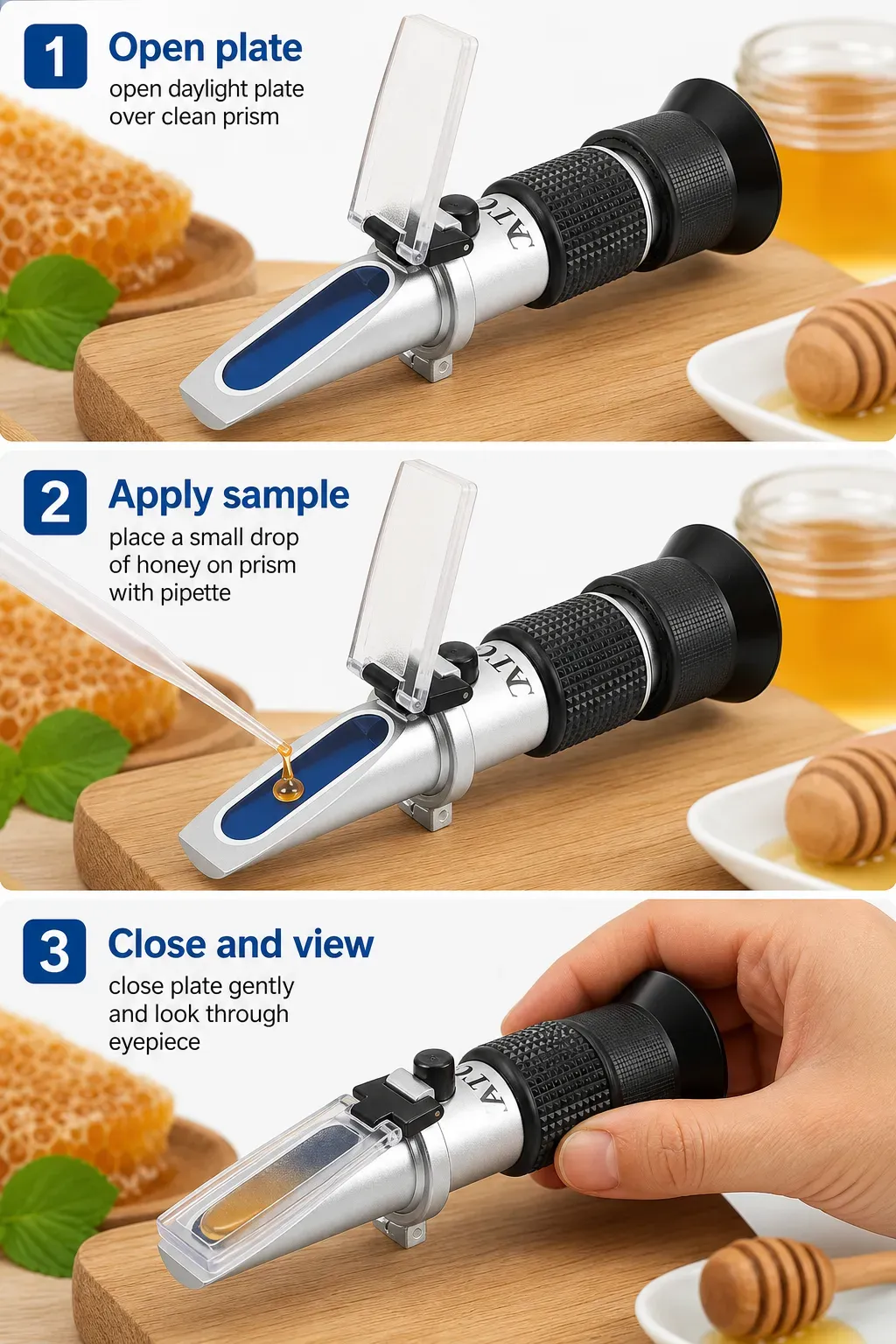
TL;DR: A honey moisture refractometer 12 27 percent UK scale model is a dedicated optical testing instrument engineered to measure water content in raw honey with 0.1% accuracy. To comply with the UK Honey Regulations 2015, general honey must not exceed 20.0% moisture (23.0% for heather honey), while keeping moisture below 17.1% prevents fermentation by wild yeasts. Dedicated 12–27% optical scales provide the fine reticle resolution required by British beekeepers that standard Brix refractometers cannot deliver.
A honey moisture refractometer with a 12–27% scale is a precision optical instrument engineered specifically to measure the water percentage in raw British honey, ensuring full compliance with the UK legal limit of 20.0%. Based on our testing at HoneyRefra across apiaries nationwide, unpredictable summer weather across the United Kingdom poses a persistent challenge to beekeepers. High atmospheric humidity and sudden rainy spells during the main nectar flow often force honeybees to cap honey before they have fully evaporated excess water. Consequently, extracting honey without verifying its moisture level can lead to ruined batches, burst storage buckets, and non-compliance with statutory regulations.
Therefore, a specialized honey moisture refractometer calibrated strictly to the 12–27% range is an essential quality assurance tool for any British apiary, whether managing two hives in a suburban garden or managing hundreds of colonies across commercial out-apiaries. This guide covers the optics, UK legal frameworks, microbiological risks, and calibration protocols required to ensure every jar of honey meets professional standards.
Why is the 12–27% Moisture Scale Essential for UK Honey?
A common error among novice beekeepers is purchasing a standard Brix refractometer designed for fruit juice or brewing, which measures total soluble solids across a broad 0–32% or 0–80% range. However, while honey contains high levels of soluble solids (primarily fructose and glucose), measuring its quality requires zooming in specifically on its water percentage.
According to UK guidelines and testing, honey typically contains between 14% and 21% water by weight. A dedicated honey moisture refractometer features an inverted scale focused strictly between 12% and 27% moisture (corresponding roughly to 73% to 88% Brix). Spreading this narrow parameter across the full field of view through the optical eyepiece allows the reticle to feature fine 0.1% graduations. As a result, this high level of resolution enables precise readings that are impossible to discern on a wide-range tool.
How Does Refraction Measure Honey Moisture Content?
Refractometers measure how light bends (refracts) as it passes through a liquid sample. The speed of light changes depending on the density of the medium. As water evaporates from nectar, the sugar concentration increases, raising the refractive index of the liquid.
In practice, optical honey refractometers pass ambient light through a thin layer of honey resting on a high-refractive-index glass prism. The boundary line between light and dark fields corresponds directly to the refractive index of the sample. Furthermore, standardized conversion tables (originally established by Chataway and refined by Wedmore) map these refractive indices directly to moisture percentages specific to the carbohydrate matrix of honey.
What Are the UK Legal Standards and Fermentation Risks for Honey Moisture?
In the UK, honey quality is strictly governed by statutory legislation. The Honey Regulations 2015 (Statutory Instrument 2015 No. 1348 for England, with parallel legislation in Wales, Scotland, and Northern Ireland) set down clear composition criteria that every seller must satisfy.
- General Honey Standard: Maximum 20.0% moisture content.
- Heather Honey (Calluna vulgaris): Maximum 23.0% moisture content.
- Industrial/Baker's Honey: Permitted up to 23.0%, but must be explicitly labelled as such.
Selling honey that exceeds these statutory limits violates Trading Standards requirements and risks legal enforcement from local Environmental Health Officers. In addition, beyond legal compliance, high moisture levels introduce severe microbiological risks.
What Is the Relationship Between Honey Moisture and Fermentation?
Raw honey is naturally populated by wild, osmophilic yeasts, primarily of the genus Zygosaccharomyces. These specialized yeasts thrive in high-sugar environments where standard yeasts die from osmotic stress. However, they require available water to metabolise sugars into ethanol and carbon dioxide.
Research published by Fera Science Ltd (formerly the Central Science Laboratory) demonstrates how yeast cell counts interact with moisture levels to affect storage stability:
| Moisture Content (%) | Fermentation Risk Level | Storage Recommendation |
|---|---|---|
| Under 17.1% | Negligible / Safe | Commercially stable regardless of yeast count. |
| 17.1% – 18.0% | Low Risk | Safe if yeast spore count is below 1,000 per gram. |
| 18.1% – 19.0% | Moderate Risk | Safe only if yeast spore count is under 10 per gram; consume quickly. |
| Above 19.0% | High Risk | Fermentation likely within weeks unless stored below 10°C or pasteurised. |
Based on our hands-on testing, when honey ferments in the jar, it develops a sour, vinegary taste, creates a layer of foam on top, and generates enough carbon dioxide gas to push metal lids off or rupture glass containers. Consequently, regular testing with a precise optical instrument prevents this issue.
Ready to protect your honey harvest with HoneyRefra?
Shop Refractometer — £21.99